
Contact Sales Now
Thank you! Your submission has been received!
Oops! Something went wrong while submitting the form.

Contact Sales Now
Thank you! Your submission has been received!
Oops! Something went wrong while submitting the form.

Selecting the correct label material is a critical engineering decision that impacts brand perception, regulatory compliance, and supply chain durability. While paper substrates serve well for short-term, ambient environments, modern packaging demands the resilience of polymer-based facestocks. Understanding the distinct mechanical and chemical properties of synthetic options ensures that the label performs as effectively as the container it adheres to.
The shift from cellulose to synthetic materials involves more than just water resistance. It requires an analysis of tensile strength, thermal stability, and conformability. Polypropylene (PP), Polyester (PET), and Polyvinyl Chloride (PVC) represent the "big three" in the film label industry. Each polymer offers a unique set of advantages designed for specific stress tests and application methods.
Synthetic labels are engineered films derived from polymers rather than wood pulp. Unlike paper, which acts like a sponge absorbing moisture and contaminants, synthetics provide an inert barrier. This fundamental difference in composition dictates how the label reacts to environmental stress, ink reception, and adhesive bonding. Professional converters prioritize these materials when longevity and aesthetic precision are non-negotiable.
The manufacturing process for these films, often involving extrusion and orientation (stretching), aligns polymer chains to create specific physical characteristics. This engineering allows for thinner calipers with higher tensile strength compared to paper equivalents. It creates a smooth, non-porous surface that requires specific surface treatments for ink adhesion but ultimately delivers a superior finish.
The primary advantage of film-based substrates lies in dimensional stability. Cellulose fibers expand and contract significantly with updates in relative humidity, leading to wrinkling, bubbling, or edge lift. Polymer films maintain their dimensions regardless of humidity levels, ensuring the label remains flat and securely adhered throughout the product capability lifecycle.
Paper substrates are inherently hygroscopic, meaning they seek equilibrium with the surrounding moisture. This causes rapid degradation of the fiber matrix when exposed to liquids. Synthetic films are hydrophobic by nature. They do not absorb water, preserving the structural integrity of the label even when submerged or subjected to condensation cycles in refrigeration.
Furthermore, the surface smoothness of film substrates is vastly superior to paper. Paper fibers create microscopic peaks and valleys that can cause ink spread or "dot gain" in printing. Films provide a consistent, flat landscape that allows for precise dot placement, resulting in sharper focus and higher resolution images essential for premium branding.
Modern supply chains expose products to extreme variables including friction, chemical exposure, and temperature fluctuation. A synthetic face stock acts as a shield. For industrial chemical drums or automotive components, the label must resist aggressive solvents that would dissolve paper fibers or destroy standard varnishes instantly.
Outdoor storage and transit introduce Ultraviolet (UV) radiation, which yellows paper and degrades standard inks. Polymer films, particularly those stabilized for UV exposure, resist brittleness and discoloration. This durability ensures that safety warnings, barcodes, and variable data remain legible from the factory floor to the end-user, adhering to compliance standards like GHS or BS5609.
Resistance to tearing is another critical factor in harsh environments. Paper tears easily when nicked or stressed. Oriented films like BOPP or PET possess high tensile strength. They resist tearing during high-speed automatic application and withstand the rough handling inherent in logistics, preventing the label from becoming compromised before the product reaches the shelf.
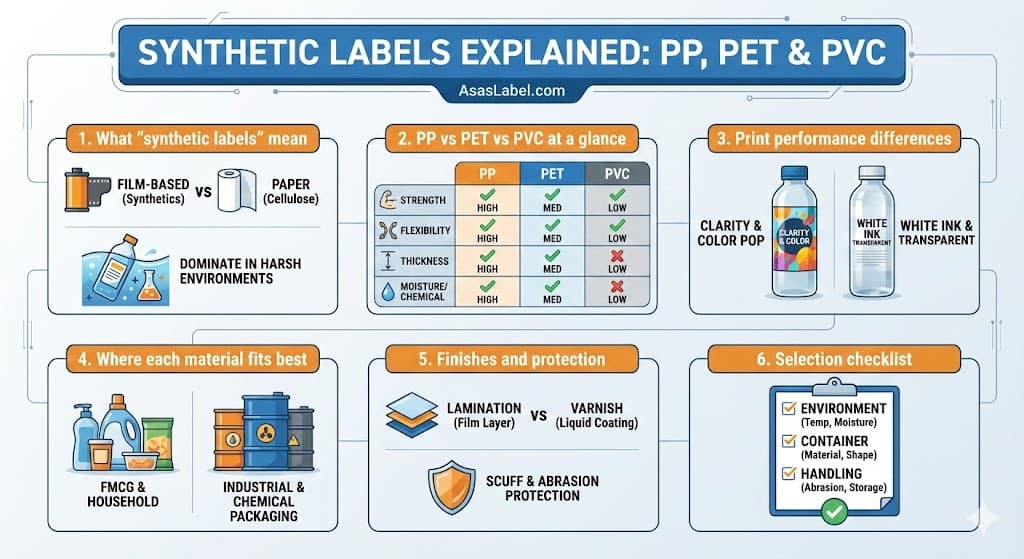
Distinguishing between PP, PET, and PVC requires looking beyond their plastic appearance. These materials offer different balances of rigidity, elasticity, and thermal resistance. The choice depends heavily on the container's geometry—whether it is a rigid glass bottle or a semi-squeezable tube—and the thermal conditions of the filling line and storage environment.
Polypropylene (PP) serves as the versatile workhorse of the label industry. Often biaxially oriented (BOPP), it is stretched in both machine and cross directions during manufacturing. This process yields a film that is stiff, clear, and resistant to stretching. It offers excellent dispensing speeds but has low conformability, making it ideal for rigid containers but poor for complex curves.
Polyester (PET) is the strongest and most rigid of the three materials. It possesses high tensile strength and does not stretch easily. This dimensional rigidity makes it the preferred choice for durable goods and asset tracking tags. Hower, its stiffness means it will flag (lift at the edges) if applied to small diameter tubes or squeezable packaging.
MDPE and Polyethylene (PE) generally handle flexibility, but PVC (Vinyl) stands out for its extreme durability combined with softness. PVC lacks the stiffness of PET or BOPP. It is highly conformable and can wrap around compound curves or pliable containers without lifting. It is physically thicker and heavier, providing a substantial tactile feel often associated with outdoor durability.
Applications requiring squeezability usually default to PE or specialized squeezable PP blends. However, where extreme durability meets a need for a non-rigid face, PVC remains a strong contender. The caliper (thickness) of PVC is generally higher, offering robust physical protection against gouging/impact that thinner BOPP films cannot provide.
While all three materials resist water, their chemical resistance profiles differ. PET is the gold standard for high-temperature and harsh chemical environments. It withstands exposure to oils, solvents, and petrochemicals without swelling or degrading. This makes it efficient for under-the-hood automotive labels and electronic component identification.
Polypropylene offers excellent resistance to water, oils, and some acids, making it suitable for household cleaners, cosmetics, and beverages. However, it is less heat-resistant than PET. Exposure to extreme heat can cause PP to shrink or distort, which limits its utility in high-temperature sterilization processes or industrial machinery labeling.
PVC excels in weathering. It provides superior resistance to UV degradation and saltwater corrosion, which explains its dominance in marine and construction applications. While it handles many chemicals well, its primary strength is surviving the elements rather than surviving immersion in aggressive industrial solvents, where PET would perform better.
Printing on non-porous substrates requires different techniques than printing on paper. Because the ink sits on top of the material rather than soaking in, the surface energy (measured in dynes) becomes critical. Converters must ensure the film is top-coated or corona-treated to allow inks to wet out properly and bond creates permanent adhesion.
Synthetic labels offer a pristine canvas that enhances color vibrancy. The lack of fiber absorption means 100% of the ink remains on the surface, resulting in higher color density and contrast. This allows for "magnetic" shelf appeal where colors appear more saturated and gloss levels are easier to control through curing.
For fine text and intricate barcodes, film is superior. The smoothness of the substrate allows for high-definition printing with no ink bleed. This is vital for pharmaceutical packaging or nutritional labels where small font legibility is a regulatory requirement. The edge definition of characters remains sharp, facilitating accurate scanning of high-density barcodes.
PET and PP films are available in various opacity levels, from super-clear to metallized silver. Metallized films (usually BOPP or PET) provide a mirror-like finish that can be overprinted with transparent inks to create metallic colors (gold, bronze, copper) without the cost of hot foil stamping. This versatility drives high-end aesthetic decisions.
Achieving the "no-label look" is a primary reason brands choose clear PP or PET. The goal is to make the graphics appear as if they are printed directly on the container. This requires a film with high transparency and an adhesive that does not whiten (blush) when exposed to moisture. Clear BOPP is the standard for this application on glass and clear PET bottles.
Printing on clear materials necessitates the use of opaque white ink. This white layer acts as an unknowable base for standard CMYK colors, preventing them from appearing translucent against the product inside the bottle. High-opacity white ink capability is a key differentiator in print quality, ensuring text remains readable regardless of the fluid color inside the container.
For clear vinyl (PVC), the inherent slight haziness or blue tint can sometimes affect the ultra-clear aesthetic compared to the crystal clarity of PET or BOPP. Therefore, for cosmetic applications demanding absolute invisibility of the label edges, clear BOPP is almost exclusively the chosen substrate.
Matching the material to the market vertical prevents failure. Over-engineering a label adds unnecessary cost, while under-engineering leads to brand damage through peeling or fading. The application environment dictates the substrate choice more than any other factor.
Fast-Moving Consumer Goods (FMCG) prioritize shelf appeal and cost-efficiency. Here, Polypropylene (PP) is the dominant player. Its clarity, moderate cost, and water resistance make it perfect for shampoo bottles, beverage containers, and food packaging. It withstands the moisture of a shower or a refrigerator without issue.
In the home and personal care sector, the "squeezability" factor complicates material selection. Standard BOPP is too rigid for a squeezable tube and will wrinkle. In these cases, brands utilize Polyethylene (PE) or blended polyolefin films. These materials flex with the container and return to their original shape, maintaining the label's appearance throughout product use.
Household cleaners often contain aggressive surfactants. While PP is generally resistant, the label needs to account for drips and spills. A laminate typically protects the ink, but the PP facestock itself remains stable. Brands favor the gloss and brightness of white PP to signal cleanliness and efficacy to the consumer.
Industrial applications demand performance over aesthetics. For chemical drums transporting hazardous materials, the label must meet BS5609 standards for seawater immersion. This often requires a heavy-duty PVC or a specialized PE label with extreme adhesive tack. The material must not delaminate even after months of outdoor storage.
Electronics and appliances utilize PET almost exclusively. The nameplates on the back of televisions or inside machinery must endure heat generated by the device. PET’s high melting point ensures the label does not shrink or curl. Furthermore, silver/chrome PET is used to mimic metal plates, providing a premium look with the cost benefits of a label.
Asset tagging and inventory control in warehouses utilize rigid PET labels. These labels often endure forklift traffic, scuffing, and varied temperatures. The stiffness of PET facilitates easy scanning and prevents the label from distorting over years of service, ensuring inventory data remains accurate.
The synthetic substrate is only half the durability equation. The surface finish protects the printed image from abrasion and chemicals. Without a protective layer, even the most durable PVC or PET label will have its ink scratched off during transit or handling.
Lamination involves applying a secondary layer of clear plastic film (usually PP or PET) over the printed label. This offers the ultimate protection. It creates a physical barrier against chemicals and heavy abrasion. Lamination also adds thickness and stiffness, which can be beneficial for high-speed dispensing but detrimental for squeezable applications.
UV Varnish is a liquid coating cured by ultraviolet light. It is less expensive than lamination and allows for spot application (coating only specific areas). While it protects against light scuffing and moisture, it does not offer the heavy-duty barrier of a laminate. Varnishes are ideal for FMCG products where cost is sensitive and heavy abrasion is unlikely.
The choice often comes down to the "coefficient of friction." Laminates can be glossy or matte, but they change how the label slides against machine rails and other bottles. Varnishes can be formulated with specific slip additives to ensure bottles don't jam on the conveyor line, a critical consideration for high-speed filling operations.
Products shipped in bulk cardboard boxes face vibrational scuffing. As the truck moves, the product rubs against the corrugated box or adjacent bottles. This friction acts like sandpaper. Synthetic labels with lamination are virtually immune to this, whereas varnished paper would show wear immediately.
For industrial PVC labels, the material's inherent softness can make it susceptible to gouging, although it resists tearing. A hard PET laminate over a PVC base creates a composite structure: the conformability and adhesion of vinyl with the hardened armor of polyester. This combination is often used in heavy machinery decals.
Matte finishes can hide minor scuffs better than high-gloss finishes. A high-gloss BOPP label shows every micro-scratch. A textured matte varnish or laminate diffuses light, masking surface imperfections that occur during the supply chain journey. This keeps the product looking pristine upon arrival.
Making the final decision requires a systematic review of the product lifecycle. Packaging engineers and brand managers should utilize a decision matrix to filter out unsuitable substrates before requesting samples or trials.
Start with the container surface energy. Adhesives bond differently to High Surface Energy (HSE) plastics like PET or PVC than they do to Low Surface Energy (LSE) plastics like raw PP or HDPE. While the face stock matters, ensuring the adhesive paired with that face stock suits the container is paramount.
Next, define the temperature range. Does the product undergo hot-filling? If yes, avoid standard PE which might stretch; choose PP or PET. Is it stored in a cryogenic freezer? Standard adhesives will crystallize and fail; specialized freezer-grade synthetics are required. The thermal expansion of the container versus the label must be compatible to prevent buckling.
Finally, evaluate the expected lifecycle duration. A shampoo bottle needs to last a few months; a serial number tag on a power drill needs to last ten years. For long-term durable goods, PET is the only logical choice due to its chemical stability. For short-term consumer goods, PP provides the best balance of cost and performance.