

Contact Sales Now
Thank you! Your submission has been received!
Oops! Something went wrong while submitting the form.

Contact Sales Now
Thank you! Your submission has been received!
Oops! Something went wrong while submitting the form.

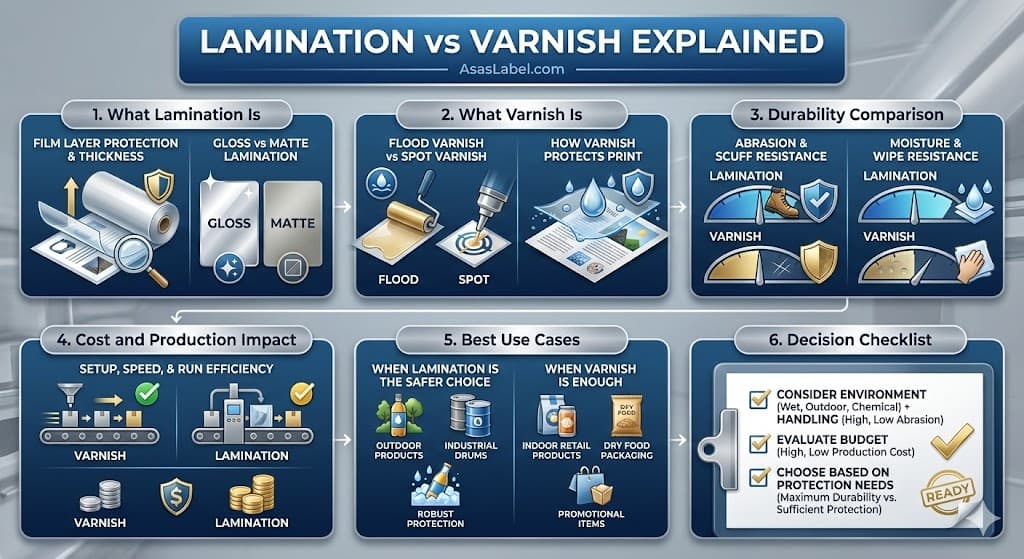
Selecting the correct finish determines the lifespan, tactile quality, and application performance of a label. The choice between lamination and varnish is rarely just an aesthetic preference. It is a calculated decision based on abrasion risk, moisture exposure, and budget constraints. Converters and brand owners must weigh physical durability against production speed.
Lamination involves adhering a separate plastic film to the substrate, creating a sandwich that physically shields the ink. Varnish acts more like a liquid topcoat that cures directly onto the material. While both seal the ink against smudging, their structural contributions to the final product differ immensely.
Understanding the mechanical differences allows for optimization in the finishing line. This ensures that the final roll resists the specific stresses of the supply chain. We will dissect the technical specifications, barrier properties, and economic implications of both finishing methods.
Lamination applies a distinct layer of polypropylene (BOPP) or polyester (PET) film over the printed substrate. This process utilizes a pressure-sensitive adhesive or thermal bonding to fuse the film to the face stock. This additional layer significantly increases the caliper (thickness) of the label construction.
The added thickness provides substantial tensile strength. This structural reinforcement is critical for labels that undergo high-speed automatic dispensing, ensuring the integrity of the label surface. The extra rigidity prevents the web from snapping under tension and assists in cleaner matrix removal during the die-cutting process.
Standard over-laminates typically range from 1 to 3 mils in thickness, while laminates vs varnish can significantly affect the final product labels. This physical barrier renders the underlying ink inaccessible to surface scratching. Unlike liquid coatings, the film absorbs the impact of abrasion without compromising the legibility of the graphics beneath it, maintaining a non-reflective surface that enhances readability.
For industrial applications, polyester laminates offer superior heat and chemical resistance compared to standard polypropylene, making them ideal for labels. The choice of film substrate dictates the upper limits of the label's durability profile. This makes lamination the default for durable goods labeling.
The adhesive layer of the laminate also plays a role in clarity. High-quality acrylic adhesives ensure that the bond does not yellow over time or obscure the glossy label finish. The lamination process essentially encapsulates the print, creating a composite material that behaves differently than the raw stock.
Gloss lamination maximizes color vibrancy and contrast, making it ideal for product labels. The smooth surface reflects light directly, creating a "wet" look that makes reds deeper and blacks richer. This finish is often preferred for retail products where shelf appeal and high-impact graphics are necessary to catch consumer attention on the label surface.
Matte lamination serves a different functional and aesthetic purpose. It diffuses light, eliminating glare and making text easier to read under harsh lighting. This diffusion creates a softer, premium feel that is increasingly popular in the wine, spirits, and luxury cosmetic sectors.
Beyond aesthetics, matte films provide a specific tactile experience that complements the label design. Soft-touch laminates add a velvety texture that varnish generally cannot replicate without expensive specialized formulations. This tactile engagement adds a sensory dimension to the branding that standard gloss finishes lack.
However, matte surfaces can slightly dull the intensity of printed colors, making it essential to consider how colors pop against different finishes. Pre-press adjustments may be required to compensate for this flattening effect. It is also worth noting that matte films are more susceptible to showing friction burns or "polishing" marks during shipping than their gloss counterparts.
Both finishes alter the label surface tension of the final label. This affects how subsequent layers, such as thermal transfer printing for variable data, adhere to the surface. Testing the specific laminate with thermal ribbons is essential for logistics and inventory labels to ensure compatibility with the label material.
Varnish is a liquid coating applied through a station on the press, similar to how ink is applied. A flood varnish covers the entire surface area of the label web. It provides a uniform seal that protects the ink from offsetting or smearing during the rewinding and finishing stages.
Spot varnish utilizes a plate or a digital print head to apply coating only to specific areas, enhancing the glossy finish and creating a striking contrast with matte and glossy finishes. This technique creates visual contrast between the substrate and the highlighted elements. It is frequently used to make logos pop or to create patterns that are visible only when the light hits at certain angles.
The application method relies heavily on the anilox roller volume in flexographic printing. Control over the coat weight is precise, allowing for very thin layers that do not significantly alter the overall thickness of the label. This is advantageous for tight tolerance applications in label design.
Registration accuracy is paramount for spot varnishing to achieve the desired sheen in the label finish. Unlike lamination, which covers everything, a misregistered spot varnish can ruin the visual intent of the design. Modern servo-driven presses maintain tight registration, making high-end spot effects consistent at production speeds.
Digital varnishing eliminates the need for plates entirely. This allows for variable textures and tactile build-up (high-build varnish) without the tooling costs associated with analog methods. It enables short-run customization that lamination cannot achieve.
Most modern label production utilizes UV-curable varnishes. When exposed to high-intensity ultraviolet light, photoinitiators in the liquid trigger a rapid polymerization process, which can enhance the reflective properties of the finish. The varnish transforms from a liquid to a solid almost instantly, creating a hard, protective layer over the ink that is ideal for labels.
Water-based (aqueous) coatings are an alternative, primarily used in food and beverage packaging where low migration is a concern. These require drying systems involving heat and air movement rather than UV curing. They generally offer lower gloss levels and less chemical resistance than UV formulations, which can affect how colors pop under bright lighting.
The chemical bond formed during UV curing provides a slick surface. This reduces the coefficient of friction, allowing labels to slide against each other during transport without scuffing. However, the protection is relatively thin compared to a film laminate.
Specialty varnishes can include additives for specific functional properties. These include anti-slip coatings for pallet stacking or release coatings for peel-and-reveal labels. The versatility of chemical formulation allows varnish to solve problems that a standard film cannot.
While varnish seals the pores of paper substrates, it does not make the paper waterproof. Moisture can still wick in from the edges or penetrate if the coating cracks. It is a surface shield, not a structural barrier, but it does enhance the visual appeal of the label.
Lamination is the undisputed leader in abrasion resistance. The presence of a physical PET or BOPP sheet means that any object rubbing against the label must wear through typically 12 to 24 microns of plastic before it can damage the ink. This is essential for items shipped in bulk without individual cartons, where the label design must withstand various conditions.
Scuffing often occurs during transit when products vibrate against corrugated cardboard. A laminated label will survive this "vibration damage" with its gloss intact. Varnish, while hard, is microscopic in thickness. Sustained friction will eventually breach the varnish layer, leading to ink loss.
For heavy-duty industrial environments, laminates and varnishes preserve barcodes and safety warnings. If a barcode becomes unreadable due to scuffing, the label fails its primary purpose, emphasizing the importance of a quality varnish coating. Lamination acts as insurance against this data loss in rugged supply chains.
Varnish provides adequate protection for "finger friction"—the normal handling a printed label receives from a consumer. For products like shampoo bottles or dry food goods, the abrasion resistance of UV varnish adds an extra layer of protection to maintain shelf appeal.
However, varnish can become brittle, especially when not paired with the right finish. If the label substrate is flexible (liking a squeeze tube), a standard hard varnish may crack, creating a spiderweb effect. laminates are inherently more flexible and move with the container without fracturing.
Lamination renders the face of the label completely waterproof. Oil, water, and solvents sit on top of the plastic film and can be wiped away without degrading the image. This is mandatory for products in the automotive, chemical, and bath and body industries.
For paper labels, lamination effectively turns a porous substrate into a synthetic-like surface, providing a more durable and elegant look. While edge-wicking can still occur if the label is submerged, surface splashes are repelled entirely. This allows brands to use textured estate papers in semi-wet environments.
Varnish offers water resistance, not waterproofing, which is crucial for labels exposed to moisture. It repels incidental moisture and humidity, providing an extra layer of protection for the label. However, aggressive wiping with cleaning agents or exposure to alcohol can break down certain varnishes or penetrate through microscopic pinholes in the coating.
In chemical drum labeling, specifically those requiring BS5609 certification, lamination is often a requirement to pass the saltwater immersion testing. Varnish rarely survives prolonged exposure to harsh marine environments or aggressive solvents like acetone or brake fluid.
If the product contents are oily (essential oils, dressings), laminates prevent the oil from staining the label material, enhancing the design elements to create an elegant look. Varnish may eventually succumb to the oil, causing the label to become translucent or the adhesive to fail due to migration when exposed to moisture.
Varnish is generally more cost-effective regarding raw materials. It is purchased in bulk liquid form and applied thinly, often as a varnish coating to enhance the label's durability. Lamination requires purchasing distinct rolls of engineered film, which significantly increases the material cost per square inch of the finished label.
Production speed is also a factor. Varnishing is an inline process that rarely limits the press speed, allowing for efficient production of printed labels. Modern presses can cure UV varnish at upwards of 500 feet per minute. Lamination, while also inline, introduces complexities regarding web tension and potential wrinkling.
Setup time for lamination involves loading heavy rolls and threading the over-laminate unit. Operator skill is required to adjust the nip pressure and tension to prevent curling. If the tension is mismatched, the labels will curl upon dispensing, causing application line failures.
Varnish setup is faster, particularly for flood coating. It involves pumping fluid into the tray and engaging the anilox. However, wash-up times for varnish stations can be longer, especially if switching between varnish types or special effect coatings.
Waste is higher with lamination, especially in the production of custom labels. Every time the press stops or the laminate roll needs changing, material is wasted. Additionally, lamination creates a thicker matrix waste stream, which can fill waste winders faster and increase disposal weight and costs.
Select lamination for any unsuspecting environment where the product faces outdoor exposure. UV-blocking laminates can extend the lightfastness of inks, preventing fading from sun exposure. This is critical for garden products, window decals, and exterior equipment signage, where choosing the perfect finish can impact durability and visual appeal.
Products prone to leakage or spillage during use require lamination. This includes automotive fluids, industrial cleaners, and cosmetics containing oils. The barrier properties ensure that the branding remains intact even if the product coats the outside of the container.
High-friction supply chains mandate lamination. If the item is heavy and shipped loose in a box (like hardware or automotive parts), the constant rubbing against cardboard requires the heavy armor of a 2-mil laminate.
Variable information printing often favors lamination. Many thermal transfer ribbons are formulated purely for synthetic surfaces, which are key differences to consider when choosing the right finish. Laminating a paper label creates the consistent, smooth surface needed for crisp barcode printing downstream.
Finally, utilize lamination for structural rigidity. If the label is large and the face stock is thin (like a metalized paper), the laminate adds the necessary body to dispense accurately without wrinkling or folding over itself.
Varnish is the correct choice for single-use packaging used in controlled environments. Food labelsShipping labels and general warehouse identification rarely justify the cost of lamination or varnish due to their functional nature. The lifespan of the label is short, and the abuse level is low.
Bio-degradable and recycling-friendly packaging often demands varnish. Plastic laminates on paper labels can render the package difficult to recycle. Using a water-based or compatible UV varnish ensures the label stream does not contaminate the recycling process, creating a more sustainable protective layer.
Direct thermal labels (heat-sensitive paper) are often varnished rather than laminated. The heat required for some thermal laminating processes would turn the paper black, highlighting the key differences between finishes. UV varnish can be applied without triggering the thermal chemistry of the paper.
High-volume runs where unit cost is paramount favor varnishes and laminates for their cost-effectiveness. In runs of millions of labels, the fraction of a cent saved per label by eliminating film adds up to substantial profitability. Mass-market beverage labels often use varnish for this reason, providing a protective layer that appeals to consumers and enhances the colors pop.
Design-specific needs requiring writability often necessitate varnish. Standard laminates are difficult to write on with a pen or pencil. A "stampable" varnish allows for date coding or lot numbers to be added manually or via inkjet coding on the packaging line.
When finalizing usage specifications, analyze the moisture variable first to ensure the protective layer is effective. If the product will be submerged, refrigerated (condensation risk), or stored outdoors, lamination is the non-negotiable safer choice. If the environment is dry and climate-controlled, varnish becomes a viable option.
Evaluate the handling lifecycle. Estimate how many times the product is touched, packed, or slid across surfaces. High-touch items like mobile phone accessories or tools need lamination or varnish to ensure longevity. "No-touch" items like inner-carton components perform perfectly well with varnish.
Consider the desired shelf life. A label meant to last five years on a piece of machinery needs the UV protection and physical bond of a laminate. A promotional sticker meant to last three weeks can utilize a basic flood varnish.
Review the tactile requirements. If the brand demands a "soft-touch" feel, lamination provides a more durable and consistent soft texture than fluid coatings. If the brand needs specific textures raised off the surface, a high-build digital varnish is the only path.
Finally, calculate the total cost of ownership. While varnish is cheaper per unit, a laminated label that prevents product returns due to damaged barcodes saves money in the long run. Balance the upfront production savings against the risk of downstream failure.