
Contact Sales Now
Thank you! Your submission has been received!
Oops! Something went wrong while submitting the form.

Contact Sales Now
Thank you! Your submission has been received!
Oops! Something went wrong while submitting the form.

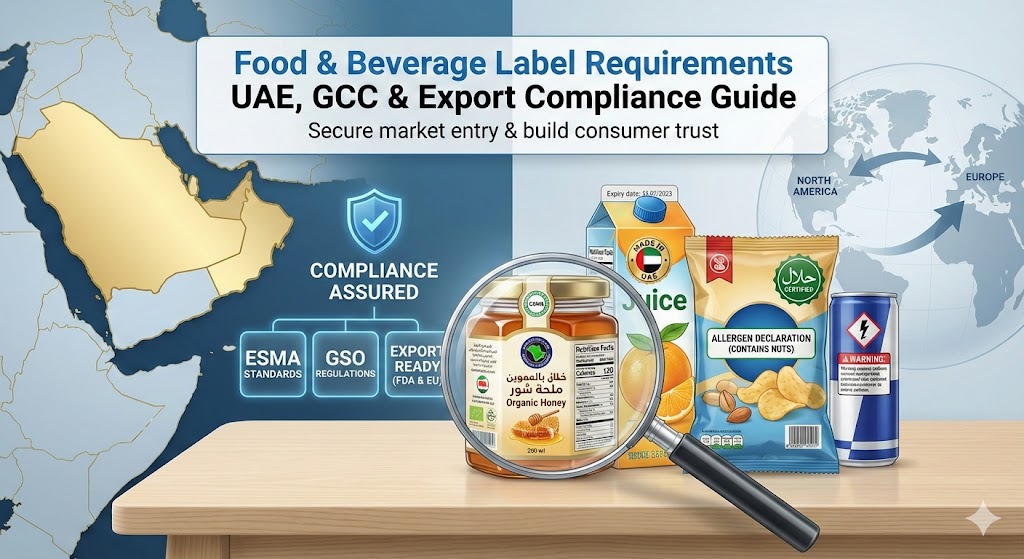
Compliance in the food and beverage sector is not merely a legal formality. It serves as the primary gateway to market entry and consumer trust. Regulatory bodies in the UAE, the wider GCC, and export markets like the US and EU enforce strict standards to ensure public safety.
Failure to adhere to these standards results in immediate rejection at customs ports. Brands face substantial financial losses when shipments are detained or destroyed due to labeling errors. The cost of a recall extends beyond the balance sheet to inflict long-term damage on brand reputation.
Navigating the intersection of multiple regulatory frameworks requires precision. A product intended for Dubai, Riyadh, and New York cannot rely on a single generic design. Specific nuances regarding language, nutritional data, and allergen declarations dictate the layout and content of every package.
ASAS Label bridges the gap between design and regulation. We ensure that technical specifications meet the rigorous demands of food safety and legal compliance. Understanding these requirements prevents supply chain disruptions and ensures products reach the shelf without delay.
Consumer safety stands as the non-negotiable priority for all regulatory bodies. Labels act as the essential communication tool regarding allergens, shelf life, and nutritional content. Accurate data prevents severe health reactions and ensures informed dietary choices for the population.
Legal requirements establish the baseline for trade. Governments utilize labeling laws to control the quality of imported and locally produced goods. Non-compliance is viewed as a violation of consumer rights and state safety protocols, leading to heavy fines.
Brand reputation relies heavily on perceived transparency and professionalism. A label riddled with errors or non-compliant formatting suggests a lack of quality control. Consumers associate the integrity of the packaging with the quality of the product inside.
Market access depends entirely on meeting specific port-of-entry standards. Customs officials review labeling documentation before inspecting the physical goods. Discrepancies between the shipping manifest and the product label often result in the rejection of entire containers.
The global framework for food regulations is fragmented yet interconnected. The Codex Alimentarius Commission sets the international benchmarks that many countries adapt. However, regional bodies like the GCC Standardization Organization and the US FDA implement distinct deviations that manufacturers must respect.
Exporting to multiple regions introduces conflicting requirements. The UAE demands Arabic as a primary language, while the EU emphasizes specific allergen highlighting styles. Balancing these contradictions on a limited surface area requires strategic layout planning and often necessitates variant printing runs.
The Emirates Authority for Standardisation and Metrology (ESMA) dictates the core standards for all food products entering the UAE. Adherence to UAE.S GSO 9 is mandatory. This standard outlines the fundamental information that must appear on every package, regardless of size or category.
Mandatory information requirements include the product name, ingredients, net weight, and origin. This data must be irremovable and clearly legible. Stickers used to correct information are often scrutinized and may be rejected if they can be easily peeled off.
Arabic language requirements are strict and non-negotiable. Arabic must be present and must be as prominent as the English text. The translation must be accurate to the technical food terminology, not a literal translation that obscures the meaning of ingredients.
Font size specifications prevent brands from hiding unfavorable information. ESMA regulations specify minimum height requirements for lettering, particularly for the product name and net quantity. Text that is too small to read without magnification causes immediate compliance failure.
Date marking requirements follow specific formats, typically Day/Month/Year. The terms "Production Date" and "Expiry Date" must be translated exactly. Ambiguous coding or American-style dating (Month/Day/Year) without clarification often leads to confusion and rejection.
The Ministry of Climate Change and Environment (MOCCAE) oversees the broader environmental and safety aspects of food imports. They focus on the registration of products in the ZAD system. Labels must match the data entered into this federal electronic system perfectly.
Additional requirements often emerge regarding food security and sustainability. MOCCAE may require specific declarations regarding raw material sourcing for certain high-risk categories. Brands must stay updated on circulars issued by the Ministry.
Registration requirements mandate that the label artwork is uploaded and approved before shipment. The physical label found on the product at the port must match the digital artwork approved in the system. Any deviation, even a minor color change, can trigger a hold.
Dubai Municipality enforces rigorous inspections through the FIRS (Food Import Re-export System). They often require specific declarations for additives and food coloring. E-numbers must be clearly identified, and specific warnings for distinct artificial colors are frequently enforced.
Abu Dhabi maintains high standards for food safety management. Their inspectors look for consistency between the label and the laboratory analysis of the food. If a label claims high protein, the lab results must verify strictly within the allowable margin of error.
The GCC Standardization Organization (GSO) unifies food standards across the six member states. GSO 9 is the technical regulation that serves as the "constitution" for food labeling in the region. It harmonizes the rules to facilitate trade between Saudi Arabia, UAE, Kuwait, Qatar, Bahrain, and Oman.
Product name rules require a description that accurately reflects the nature of the food. Fancy names or marketing terms cannot replace the technical standard name. For example, a "Chocolatey Treat" must be legally defined as a "Cocoa-Coated Wafer" if it does not meet chocolate standards.
The ingredients list must be arranged in descending order of weight (m/m) at the time of manufacture. This provides consumers with a clear understanding of the primary components. Water and volatile ingredients must be listed unless they evaporate during processing.
Net quantity declarations must follow the metric system (grams, kilograms, milliliters, liters). Imperial units can be included but must be secondary to the metric declaration. The font height for the net weight is regulated based on the surface area of the package.
Country of origin labeling is critical for tariff and safety tracking. The label must state "Made in [Country]" or "Product of [Country]." Ambiguous terms like "Packed in" or "Assembled in" require further clarification regarding the origin of the primary ingredients.
Manufacturer information must include the full physical address of the processor or packer. A website or PO Box is insufficient. This ensures traceability in the event of a safety recall or consumer complaint.
Date of production and expiry is the most scrutinized element. The regulations specify which products require specific expiration dates and which non-perishables might be exempt. However, providing a production date is almost always mandatory for traceability.
Storage instructions are vital for food safety. Terms like "Keep Refrigerated" or "Store in a Cool Dry Place" must be prominent. If the product shelf life depends on specific storage conditions, these conditions must be clearly stated next to the date mark.
Nutritional information compliance is mandatory under GSO 2233. This standard dictates the nutrients that must be displayed and the units of measurement. The transition from voluntary to mandatory nutritional labeling is now fully enforced across the GCC.
Translation standards go beyond Google Translate. The Arabic text must adhere to GSO terminology. Certain additives and chemical compounds have specific Arabic names recognized by regulators. Using dialect or colloquial terms is not permitted.
Typography requirements ensure legibility. The Arabic text cannot be smaller than the foreign language text. It must be consolidated in one area or mirrored directly against the English text. Using a font that simulates handwriting or calligraphy is discouraged if it affects readability.
Halal certification is a prerequisite for all animal-based products and many processed foods. The label must carry the Halal mark from a certification body recognized by the UAE or GCC accreditation centers. Self-declaration of Halal status is strictly prohibited.
Logo placement should be prominent but must not interfere with mandatory text. The specific logo of the certification body implies that the entire supply chain has been audited. Misuse of Halal logos is treated as a severe fraud offense.
Certification body information may need to be detailed on the packaging or accompanying documentation. This links the product to a specific valid certificate. Customs officials verify the batch number against the Halal certificate presented at the port.
The US FDA imposes the Code of Federal Regulations (CFR) Title 21. "FDA food labels" differ significantly from international standards. The layout of the Nutrition Facts panel is highly specific, requiring bold text for calories and specific indentation for sub-nutrients.
Ingredients declaration under FDA rules requires the listing of sub-ingredients in parentheses. Water added for processing must be declared. The names of ingredients must follow the "Common or Usual Name" regulations defined by the FDA.
Allergen labeling adheres to FALCPA (Food Allergen Labeling and Consumer Protection Act) and the newer FASTER Act. Sesame was recently added as the 9th major allergen. These must be listed in a "Contains" statement or within the ingredients list using common names.
Net contents declaration in the US requires both metric and US Customary units (e.g., Net Wt 1 lb (454 g)). This dual declaration must appear in the bottom 30% of the Principal Display Panel (PDP), parallel to the base of the package.
Identity statement rules require the product name to be one of the principal features on the PDP. It must be in bold type and roughly parallel to the base. The size must be reasonably related to the most prominent printed matter on the panel.
Regulation (EU) No 1169/2011 governs food labeling in Europe. It consolidates rules on nutrition and general labeling. A key difference is the minimum font size for the "x-height" of characters, which must be at least 1.2mm for readability.
14 major allergens must be emphasized directly within the ingredients list. The EU does not encourage a separate "Contains" statement for mandatory allergens. Instead, allergens must be bolded, italicized, or underlined within the ingredient block itself.
Nutritional declaration in the EU focuses on energy values in both kJ and kcal. The order of nutrients differs from the US format. Salt must be declared as "Salt," not "Sodium," to ensure consumer understanding of intake levels.
Country of origin rules have expanded in the EU. Mandatory origin labeling applies to fresh meat, fruits, and vegetables. For processed foods, if the primary ingredient comes from a different place than the "Made in" country, this distinction must be stated.
Language requirements in the EU are complex. The label must be in a language easily understood by the consumers of the Member State where the food is marketed. Multilingual labels are standard practice to cover efficient distribution zones.
Since leaving the EU, the UK has retained most EU-derived laws but with specific adjustments. Manufacturers must now include a UK-based address for the Food Business Operator (FBO). An EU address is no longer sufficient for goods sold in Great Britain.
The Saudi Food & Drug Authority (SFDA) enforces strict added sugar limits and front-of-pack warning labels for high sugar/salt content. Their enforcement of Halal standards is exceptionally rigorous, requiring center-level certification.
Australian and New Zealand standards (FSANZ) mandate strict Country of Origin Labeling (CoOL) with visual bar charts indicating the percentage of Australian ingredients. They also have distinct allergen warning formats (Plain English Allergen Labelling).
Canadian CFIA requirements demand bilingual labeling in English and French. The font size, layout, and specific terminology must be equal for both languages. Canada also has specific rounding rules for nutritional data that differ from the US.
The UAE requires a tabular format for nutritional data. The required nutrients typically include Energy, Protein, Carbohydrates, Fats, and Sodium. Trans fats and Cholesterol declarations are often mandatory depending on the product category.
Serving size declaration helps consumers gauge intake. However, unlike the US, the UAE and GCC often place heavy emphasis on values per 100g or 100ml. This allows for direct comparison between different products on the shelf.
Format requirements dictate that the table must be bordered and clearly separated from other text. If space is limited, a linear format may be permitted, but a tabular layout is always the preferred method for clarity.
Per 100g/100ml declaration is the standard reference point in the GCC. This metric standardization prevents misleading serving sizes from obscuring the true nutritional density of the product. It is the primary column required in the nutritional table.
Additional per serving information is voluntary but recommended. If included, the serving size must be realistic and reflect the amount a consumer actually eats. Unrealistic serving sizes used to lower calorie counts are flagged by regulators.
The updated format (2020) places massive emphasis on "Calories" and "Serving Size" with larger, bolder type. The footnote explaining Daily Values has been simplified. "Added Sugars" is now a mandatory line item to distinguish intrinsic sugars from those added during processing.
Daily Value percentages guide consumers on whether a nutrient is high or low. The FDA uses updated scientific evidence to set these values. Vitamin D and Potassium are now mandatory, while Vitamins A and C have become voluntary.
The EU requires the declaration of Energy, Fat, Saturates, Carbohydrate, Sugars, Protein, and Salt. This "Big 7" is the standard block. Fiber is not mandatory but can be added. The energy value must be given in both kilojoules (kJ) and kilocalories (kcal).
Format options in the EU allow for the nutrition table to be placed on the back of the pack. However, Front-of-Pack (FOP) nutrition labeling, such as the Nutri-Score system, is gaining traction in several member states as a voluntary supplementary measure.
The GSO standards list specific allergens that trigger mandatory declaration. This list aligns closely with the Codex Alimentarius. It includes gluten, crustaceans, eggs, fish, peanuts, soybeans, milk, and tree nuts. Sulfites above 10mg/kg must also be declared.
Declaration format in the GCC allows for a "Contains" statement following the ingredients list. The source of the allergen must be clear. For example, "Casein" must be followed by "(Milk)" to ensure clarity for the consumer.
FALCPA identifies the "Big 8" (now "Big 9" with sesame). The specific name of the food source must be declared. For tree nuts, the specific type (e.g., almond, walnut) must be listed. Broad terms like "nuts" are not compliant.
"Contains" statements are the preferred method for summary. The FDA requires this statement to be adjacent to the ingredients list. The font size cannot be smaller than the ingredients text.
The 14 mandatory allergens include less common triggers like celery, mustard, lupin, and mollusks. This list is more extensive than the US version. Manufacturers exporting to the EU must audit their supply chains for these specific ingredients.
Emphasis requirements mandate that the allergen name is typeset differently within the ingredients list. This is usually done via bold font. Using a separate "Contains" box without highlighting the ingredient in the main list is technically non-compliant in the EU.
Cross-contamination warnings ("May contain traces of...") are voluntary but crucial for liability. However, they must not be used as a substitute for Good Manufacturing Practices (GMP). Regulators frown upon blanket "may contain" statements used to cover up poor cleaning protocols.
Juice percentage declaration is mandatory for any fruit drink. The label must explicitly state "Contains X% Fruit Juice." If the product contains no juice, it must be labeled as "Fruit Flavored Drink" rather than "Fruit Drink."
Caffeine warnings are critical for sodas and teas. If caffeine is added, it must be listed. High-caffeine content often triggers additional warning statements advising against consumption by children or pregnant women.
Added sugar information is a focal point for beverage label compliance. Many GCC countries have implemented excise taxes on sweetened drinks. The label must accurately reflect sugar content to determine the tax category and compliance with sugar reduction initiatives.
Source declaration is the defining feature of bottled water labels. The label must state whether the water is "Spring Water," "Mineral Water," or "Purified Water." Misrepresenting treated municipal water as spring water is a serious violation.
Treatment methods such as ozonation, reverse osmosis, or UV filtration must be declared. This transparency informs the consumer about the processing the water has undergone.
Mineral content analysis (Calcium, Magnesium, Sodium, pH) must be printed on the label. In the UAE, the composition table is verified against regular lab testing. Fluctuations in mineral content beyond the allowed variance can lead to recalls.
Ingredient warnings are extensive for energy drinks. Warnings regarding taurine, glucuronolactone, and high caffeine levels are mandatory. The label must state "Not suitable for pregnant women, nursing mothers, persons under 16, or those sensitive to caffeine."
Consumption limits are often required on the can. Text such as "Do not exceed two cans per day" is a regulatory requirement in markets like Saudi Arabia and the UAE to prevent acute caffeine toxicity.
Age restrictions are strict. Energy drinks are not to be marketed to children. The labeling design should not feature cartoon characters or imagery that appeals specifically to a demographic under 16 years of age.
ABV declaration (Alcohol by Volume) allows consumers to gauge potency. The tolerance for error is very low. In export markets, the class of alcohol (e.g., "Spirit," "Wine," "Malt Beverage") determines tax classes and must be accurate.
Health warnings differ by region. The US requires the Government Warning regarding pregnancy and operating machinery. EU nations have varying requirements regarding pregnancy warning logos.
Import requirements for alcohol are bureaucratic. In Islamic countries where alcohol is permitted for non-Muslims (like UAE), the import process involves specialized licenses. The labeling must be discreet and comply with specific distribution channel rules.
Certification requirements dictate that you cannot use the word "Organic" without proof. A recognized body must certify the farm and the processing facility. The paper trail must be complete from seed to shelf.
Logo usage is restricted to certified products. In the UAE, the Ministry of Industry and Advanced Technology (MoIAT) oversees organic inputs. For exports to the EU, the "Green Leaf" logo is mandatory, but only if 95% of agricultural ingredients are organic.
UAE/GCC organic standards align with international norms but require local recognition. Imported organic goods often need a certificate of conformity to be sold as organic in the local market.
The certification process involves a physical audit of the factory. The auditor checks ingredients, cleaning agents, and segregation from non-Halal items. It is not just about pork or alcohol; it covers the entire sanitary process.
Logo specifications must match the accrediting body exactly. Generic "Halal" stickers bought off the shelf are not accepted by customs. The logo must belong to the specific agency that conducted the audit.
Slaughter method declaration is required for meat and poultry. The label often needs to specify that the animal was slaughtered according to Islamic Rites, especially for raw meat products.
Approved claims are limited to a positive list. You can say "Calcium contributes to normal bone maintenance" if the calcium levels meet the threshold. You cannot say "Calcium cures osteoporosis." Claims must be functional, not medicinal.
Substantiation requirements mean you must have scientific evidence for any claim made. If a product claims to "boost immunity," the manufacturer must be ready to provide clinical data or reference authorized regulatory lists that support the ingredient's effect.
Prohibited claims generally include any statement that implies the food can prevent, treat, or cure a human disease. Such claims reclassify the food as a drug, subjecting it to pharmaceutical regulations.
Genetically Modified Organism (GMO) regulations vary wildly. The EU has strict labeling for any ingredient with >0.9% GMO content. The UAE and GSO have recently updated standards that mandate the declaration of GMO ingredients, requiring clear triangular warning symbols in some jurisdictions.
Vegan labeling implies a total absence of animal products, including processing aids like isinglass or casein glue in labels. "Plant-Based" is a growing category, but regulators are cracking down on using dairy terms (like "Almond Milk" or "Vegan Cheese") on the label.
Food-contact materials must not leach chemicals into the product. Even secondary packaging like the label must be safe. Low-migration inks are essential if there is any risk of the ink components migrating through thin packaging.
FDA-approved inks and adhesives are industry standards. Using compliant adhesives ensures that the glue does not contaminate the food. ASAS Label prioritizes materials that meet FDA 21 CFR 175.105 for indirect food additives.
Moisture resistance is vital for chilled products. Paper labels absorb water and disintegrate in humid fridges. Polypropylene (PP) or Polyethylene (PE) films are necessary to maintain label integrity in wet environments.
Refrigeration and freezer compatibility depends on the adhesive. Standard acrylic adhesives may crystalize and fail at sub-zero temperatures. Hot-melt or freezer-grade adhesives are required to keep the label attached to frozen meats or ice cream.
Water resistance prevents the ink from running when the bottle sweats. For beverages, the label material and the protective varnish must withstand constant condensation without bubbling or peeling.
Condensation handling involves selecting materials that don't wrinkle when the container expands or contracts. Synthetic films offer the flexibility needed to move with the bottle during temperature changes.
Temperature ranges dictate the lifecycle of the label. A label applied to a hot-fill jar faces different stress than a label applied to a frozen box. The material spec sheet must match the application temperature and the service temperature.
Abrasion resistance ensures the text remains legible after shipping. Bottles vibrate against each other in transit. A scuff-resistant varnish or lamination protects the critical regulatory text from being rubbed off.
GS1 standards are the global language of supply chains. The barcode must be printed with high edge contrast to ensure scanning at checkout. A truncated (shortened) barcode often fails to scan and should be avoided if possible.
Placement requirements dictate that the barcode should be on a flat surface. Printing a barcode around a sharp curve or on a crinkled seam makes it unreadable. It should also be placed away from other graphic elements.
Quality specifications refer to the print rating. A barcode grading of C or better is usually required by major retailers. Thermal transfer or high-quality flexo printing ensures the lines are crisp and scannable.
When required, tamper-evidence provides safety assurance. This is mandatory for many pharmaceutical-adjacent foods and baby products. It indicates if the package has been opened prior to purchase.
Types of security features include shrink sleeves that cover the cap, void labels that leave a residue when peeled, or destructible vinyl that fragments upon removal. These features protect brand integrity and consumer safety.
Primary vs. secondary information structure is key. The product name and net weight must be the most dominant features on the PDP. Marketing slogans should never overpower the legal identity of the product.
Size requirements are absolute. The "x-height" of the font determines compliance. Designers cannot scale down the ingredients list to make room for a larger logo. Legibility takes precedence over aesthetics.
Positioning rules usually mandate that mandatory info is grouped together. Scattering ingredients, nutrition, and address details across different sides of the package frustrates consumers and inspectors alike.
Layout considerations for bilingual labels require managing Right-to-Left (Arabic) and Left-to-Right (English) text flow. The design must accommodate the fact that Arabic text often expands horizontally more than English.
Font requirements dictate that the Arabic font must be a standard, legible typeface. Using stylized Arabic calligraphy for the ingredients list is a compliance risk. Both languages should be roughly the same point size.
Equal prominence rules mean you cannot hide the Arabic translation on the bottom flap. In the UAE and KSA, Arabic is the official language. It deserves equal, if not superior, real estate on the label.
Contrast requirements are strictly enforced for readability. Light gray text on a white background is not compliant. There must be sufficient contrast between the text and the background for the information to be readable by the average consumer.
Color coding is frequently used for allergens or nutritional warnings (like traffic light systems). These colors must follow the specific hex codes or Pantone references defined by the regulator to ensure consistency.
DD/MM/YYYY vs. MM/DD/YYYY is a classic export pitfall. The UAE standard is Day/Month/Year. US products often use Month/Day/Year. To avoid rejection, the alphanumeric format (01-JAN-2025) is the safest global option.
Batch numbering is essential for traceability. It acts as the link between the specific product unit and the manufacturing record. It must be printed clearly, usually via inkjet coding on the production line.
Traceability requirements mean that if a specific batch of raw flour is recalled, the manufacturer can identify exactly which finished cookie boxes contain that flour using the batch code.
Universal elements should be identified first. The brand logo, product image, and net weight (in metric) are often consistent. These form the static base of the label design.
Variable elements approach involves leaving space for market-specific text. Manufacturers can use a "master label" and overprint the specific language or distributor details for the destination country.
Modular label design creates sections. One panel is English/French for Canada, another is Arabic/English for the GCC. This allows a single SKU to service multiple regions, provided the label surface area is large enough.
Short-run compliance testing is a major benefit of digital printing. Brands can print 500 labels to test a new market or submit for municipality approval before committing to 50,000 rotogravure cylinders.
Market-specific variations are easy with digital. You can print 1,000 labels for Oman and 1,000 for Bahrain in the same run, changing only the distributor address, without stopping the press.
Overprinting allows brands to use generic stock and add specific data later. This is cost-effective for dates, batch codes, and even localized ingredient lists. It reduces inventory waste of pre-printed labels.
Reviewing the digital proof is the cheapest stage to catch errors. Once plates are made, changes become expensive. The review should involve a checklist of every mandatory field required by the target market's regulation.
Regulatory consultants provide an insurance policy. They stay updated on daily circulars and shifts in the law. Investing in a third-party review of the artwork can save thousands in potential fines.
In the UAE, the Label Approval (item registration) in systems like ZAD or FIRS is mandatory. You cannot ship until the system says "Approved." This digital approval should be secured before mass printing begins.
The label is just one part of the puzzle. The Health Certificate and Certificate of Origin must align perfectly with the label. If the label says "Beef," the certificate cannot say "Meat Products." Precision in terminology is vital.
Common mistakes include typos in Arabic, incorrect date formats, undeclared allergens, and inconsistent net weight declarations. Another frequent error is covering mandatory text with a promotional sticker.
Food-grade materials and inks are our standard. We do not compromise on safety. We utilize verified substrates that adhere to international food safety regulations, ensuring your packaging is as safe as the food inside.
FDA-approved components are sourced to guarantee compliance for export markets. Whether you need moisture-resistant films for freezers or high-tack adhesives for textured jars, we have the technical solution.
Compliance consultation support is part of our service. We don't just print; we guide. We understand the nuances of ESMA and GSO standards and help you navigate the complexities of bilingual layouts.
Multi-market label production is executed with precision. We utilize advanced digital and flexographic technologies to manage variable data, ensuring you can serve domestic and export markets efficiently.
Quality control processes at ASAS Label involve automated inspection systems. We verify text, barcodes, and color consistency to ensure every roll that leaves our facility is ready for the production line.
Regulatory updates service keeps us—and you—ahead of the curve. As laws regarding nutrition panels or sustainability claims change, we adapt our production methods to ensure you remain compliant.
Is Arabic mandatory on all UAE food labels?Yes, Arabic is mandatory. It must be present, accurate, and legible. English is widely used but secondary to Arabic in the eyes of the law.
What are the font size requirements for ingredients?Generally, the minimum font size for mandatory information is based on the x-height of the characters. In the UAE/GSO, it is typically not less than 1.5mm or 1mm depending on package surface area.
How do I calculate nutritional information?Nutritional values should be derived from laboratory analysis of your final product or calculated using reputable nutritional databases based on your recipe ingredients. Lab analysis is preferred for accuracy.
Can I use the same label for UAE and Saudi markets?Often yes, as both follow GSO standards. However, slight differences in enforcement (like front-of-pack warnings in KSA) may require minor variations.
What's the difference between "Best Before" and "Use By"?"Use By" relates to safety; food should not be eaten after this date (e.g., fresh meat). "Best Before" relates to quality; food is safe but may lose flavor or texture after this date.
Are QR codes accepted for nutritional information?QR codes are becoming popular for supplementary info (smart labels), but they currently do not replace the mandatory printed nutritional table on the physical package in most jurisdictions.
How often do regulations change?Regulations evolve constantly. Major updates (like the recent nutritional table changes) happen every few years, but minor circulars regarding additives or specific ingredients can be issued at any time.
Staying compliant in the food and beverage industry is a dynamic challenge that demands constant vigilance. The cost of a non-compliant label is measured in lost revenue, destroyed stock, and damaged trust. By adhering to UAE, GCC, and international standards, manufacturers protect their business and their consumers.
ASAS Label serves as your strategic partner in this journey. We combine regulatory knowledge with high-quality printing to deliver labels that perform on the shelf and pass through the port. Do not leave your market entry to chance.
Schedule a compliance consultation with ASAS Label today or download our comprehensive compliance checklist to ensure your next shipment is audit-ready.