
Contact Sales Now
Thank you! Your submission has been received!
Oops! Something went wrong while submitting the form.

Contact Sales Now
Thank you! Your submission has been received!
Oops! Something went wrong while submitting the form.

Label printing technology has evolved rapidly from simple letterpress origins to a sophisticated landscape of high-speed engineering. The choice of printing method defines the quality, cost structure, and turnaround time of your packaging. Understanding the mechanics behind these technologies ensures your brand maximizes budget efficiency without sacrificing shelf appeal.
Selecting the wrong production method leads to inflated unit costs and potential supply chain bottlenecks. High-volume orders on digital presses burn budget unnecessarily, while short runs on offset presses incur prohibitive setup fees. The correct technology alignment transforms packaging from a cost center into a competitive advantage.
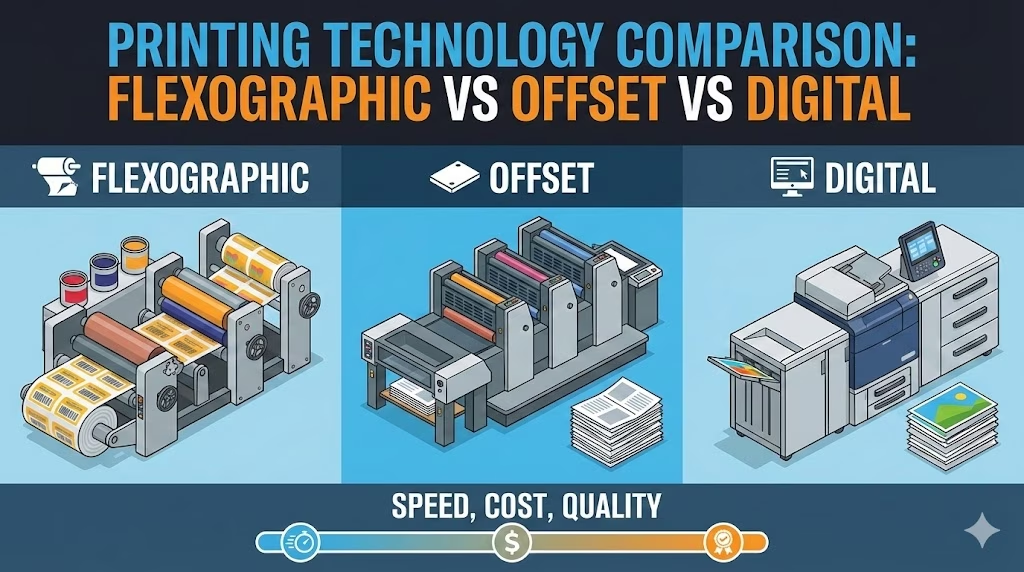
This guide analyzes the three dominant forces in the label industry: Flexography, Offset, and Digital printing. We dissect the technical specifications, economic thresholds, and visual capabilities of each. ASAS Label leverages a multi-technology approach to ensure every project utilizes the machinery best suited for its specific volume and design requirements.
Label production began with traditional letterpress, a slow relief printing method that dominated for decades. While effective for simple designs, it lacked the speed and substrate versatility required by modern consumer goods. The limitations of letterpress paved the way for more robust rotary technologies.
Flexography emerged as the direct successor to letterpress, utilizing flexible plates to print on varied materials at high speeds. It rapidly became the industry standard for packaging due to its ability to handle non-porous substrates like films and foils.
Offset printing eventually migrated from the commercial paper world to label converting. It brought superior lithographic quality to the adhesive label market, offering unrivaled detail for premium wine, spirit, and cosmetic brands requiring photographic precision.
The digital revolution disrupted the status quo by eliminating printing plates entirely. This shift allowed for cost-effective short runs and variable data, changing how brands approach seasonal promotions and SKU proliferation.
Modern production relies on a triad of technologies, each serving a distinct operational niche. Flexography dominates high-volume, variable-substrate work. Offset commands the premium, high-detail sector. Digital rules the short-run, quick-turnaround market.
Visual requirements drive the initial technical assessment. Designs requiring heavy solids, metallic inks, or microscopic text dictate specific machinery. A label with complex gradients may favor offset, while a design requiring vibrant solid colors often suits flexography.
Economic volume serves as the second major filter. The "crossover point" is the specific quantity where one technology becomes cheaper than another. Identifying this threshold is critical for procurement efficiency.
Substrate compatibility is the final logistical constraint. Textured papers, synthetic films, and metallic foils react differently to ink systems. Ensuring the ink anchors correctly to the material requires matching the print engine to the substrate surface tension.
Flexography is a rotary relief printing process. It utilizes flexible photopolymer plates wrapped around rotating cylinders. The raised image area of the plate receives ink and transfers it directly to the substrate moving at high speed.
The anilox roller system is the heart of the flexo press. This laser-engraved ceramic cylinder meters the exact volume of ink transferred to the printing plate. The cell count and volume of the anilox determine color density and print resolution.
Ink transfer occurs in a fluid, continuous motion. The substrate passes between the plate cylinder and an impression cylinder. The pressure transfers the image, followed immediately by drying or curing stations before the next color is applied.
In-line presses are the standard for modern label converting. Print stations are arranged in a horizontal row, allowing for easy access and the integration of value-added finishing units like foil stamping and rotary screen printing.
Central impression (CI) presses arrange print stations around a single large cylinder. This design maintains tight registration on stretchable materials, making it ideal for thin films and shrink sleeves, though less common for pressure-sensitive labels.
Stack presses arrange stations vertically. While space-saving, they often lack the registration precision of modern in-line servo-driven machines. They are generally reserved for simpler industrial printing applications.
Modern flexo presses utilize multiple color stations, typically ranging from 8 to 12 units. This allows for the standard CMYK process set plus distinct spot colors, varnishes, and special coatings in a single pass.
ASAS Label operates advanced 10-color flexographic configurations. This extended gamut capacity allows for complex designs utilizing Process colors alongside specific brand Pantones and protective coatings without requiring a second pass.
The maximum web width of 370mm accommodates a vast range of label sizes. From small pharmaceutical vials to large industrial drum labels, this width optimizes material usage and throughput efficiency.
Inline finishing capabilities define the efficiency of the ASAS flexo workflow. Die-cutting, lamination, and waste removal occur on the same machine, delivering a finished roll ready for application immediately after printing.
Water-based inks are prevalent in the food and beverage sector. They cure through evaporation and absorption. These inks are environmentally friendly and low-odor, making them compliant with strict consumer safety regulations.
UV-curable inks cure instantly when exposed to ultraviolet light. They sit on top of the substrate rather than soaking in, resulting in higher gloss levels and sharper dot structures. They offer excellent resistance to chemicals and abrasion.
Solvent-based inks are less common in narrow-web label printing due to VOC emissions. However, they remain relevant for specific non-porous films where chemical bite is necessary for adhesion.
LED-UV inks represent the latest advancement in curing technology. They require less energy and generate less heat than standard UV, allowing for printing on heat-sensitive materials without distortion.
Offset label printing utilizes lithographic principles where oil and water do not mix. The image area on the plate attracts oil-based ink, while the non-image area attracts a water-based dampening solution.
The image is not printed directly from the plate to the substrate. Instead, it is transferred (offset) to a rubber blanket cylinder, which then transfers the image to the paper or film. This creates a smoother image and prolongs plate life.
Plate imaging relies on creating hydrophobic (water-repelling) and hydrophilic (water-attracting) areas. High-resolution lasers burn these distinct areas onto aluminum plates with extreme precision.
Sheet-fed offset dominates commercial printing but is slower for packaging. It prints on individual sheets rather than rolls, making it less efficient for automatic label application lines.
Web offset presses feed from a roll, combining the quality of lithography with the speed of rotary production. These machines are the gold standard for high-volume, high-quality wine and spirit labels.
UV offset modifies the traditional process by using UV-curing inks. This eliminates the drying time associated with conventional oil inks, allowing for immediate finishing and processing of the label roll.
ASAS Label utilizes a 6-color offset configuration. This setup captures the nuance of photographic imagery and complex gradients that other methods may struggle to reproduce smoothly.
The Computer-to-Plate (CTP) system ensures the highest possible fidelity. By eliminating film negatives, the digital data is written directly to the offset plate, maintaining dot integrity and registration accuracy.
Online die-cutting integrated with the offset press creates a seamless workflow. Labels are printed, cured, and cut in a continuous process, reducing handling damage and shortening lead times.
We handle all finishing types inline or offline. This flexibility allows for the addition of complex embellishments like hot foil or embossing to offset-printed base labels.
Conventional offset inks dry through oxidation and absorption. While cost-effective, they require time to set before finishing, which can delay production schedules on urgent orders.
UV offset inks cure instantly under lamps. This technology allows offset quality to be achieved on non-porous films and synthetics that cannot absorb conventional oils.
Hybrid inks combine features of different chemistries to optimize adhesion and finish. These systems allow printers to switch between substrate types without extensive machine wash-ups.
Digital printing eliminates the physical matrix entirely. There are no plates, cylinders, or physical tools required to generate the image. The digital file transfers directly to the print engine.
Direct imaging technology allows for every repeat length to be unique. This capability is the foundation of variable data printing, where text, barcodes, or images change with every single label revolution.
The absence of printing plates removes significant setup costs. For short runs, this absence of tooling makes digital printing exponentially cheaper than analog counterparts.
Inkjet technology jets microscopic droplets of ink onto the substrate. UV inkjet offers durability and speed, while water-based inkjet provides food-safe compliance and high resolution on paper stocks.
Electrophotographic printing uses charged toner particles, similar to office laser printers but on an industrial scale. Liquid ElectroPhotography (LEP) fuses ink to the substrate, providing a look and feel very similar to offset.
Laser printing systems are less common for prime labels but exist for specific industrial marking applications. They offer extreme durability but limited color gamut compared to inkjet or LEP.
ASAS Label is strategically integrating digital capabilities, with full implementation targeted for 2026. This expansion aims to service the growing demand for ultra-short runs and rapid prototyping.
The focus for this implementation is strictly short-run efficiency. It will allow clients to order test batches or limited editions without the setup fees associated with our flexo and offset machinery.
Digital capacity will complement, not replace, existing lines. It functions as a support mechanism for the heavy-duty analog presses, taking on small jobs to keep the high-speed lines free for volume production.
Resolution improvements have closed the gap with analog. Modern digital presses now routinely print at 1200 dpi or higher, rendering text and barcodes with exceptional sharpness.
Color gamut expansion now exceeds the standard CMYK space. Digital presses often include Orange, Violet, and Green inks to simulate Pantone colors with 90% accuracy or higher.
Substrate compatibility has widened significantly. Primers and pre-coatings allow digital presses to print on standard flexo materials, including textured wine papers and clear films.
Line screen frequency defines detail sharpness. Flexography typically operates between 133 and 200 lines per inch (lpi). While high, it can sometimes show a hard edge on very soft fades (vignettes).
Offset printing comfortably handles 150 to 300 lpi. This high frequency creates seamless gradients and photographic reproduction. It is the preferred choice for designs with subtle shading or skin tones.
Digital printing measures quality in dots per inch (dpi). With resolutions exceeding 1200 dpi, digital creates apparent continuous tones. However, upon close magnification, the rosette pattern of analog print is replaced by a stochastic scatter of dots.
Flexo offers excellent color matching. Because physically mixed spot inks are used, Brand PMS 485 Red will be exactly PMS 485 Red, provided the ink kitchen mixes it correctly.
Offset reproduction of Pantone colors is generally precise. However, maintaining color balance across a long run requires skilled operators to manage the ink-water balance carefully to prevent color drift.
Digital color management relies on simulation. A digital press builds "Pantone" colors using CMYK+OVG. While accurate for 90% of the spectrum, certain bright neons or clean pastels may fall outside the digital gamut.
Halftone dot structures vary by process. Offset dots have soft edges, blending well. Flexo dots can suffer from "dot gain," where the dot physically squashes larger during printing, darkening the image.
Continuous tone reproduction is offset's stronghold. The lithographic process creates smooth transitions that flexo plate breaks sometimes struggle to replicate without a visible "hard edge."
Fine detail rendering favors offset and digital. Flexo plates can struggle to hold extremely small isolated dots (highlights), leading to a "drop-off" where the print suddenly disappears rather than fading to zero.
Pantone and spot colors are best achieved via analog methods. Flexo and Offset use pre-mixed inks, ensuring vibrancy and solidity that CMYK builds cannot replicate.
Metallic inks print effectively in Flexo. The heavy laydown of ink allows metallic flakes to align and reflect light. Digital metallic options exist but often lack the sheer brilliance of a physical metallic ink.
White ink opacity is critical for clear labels. Flexographic screen heads lay down thick, opaque white. Digital white is improving but often requires multiple hits (passes) to achieve the same opacity, slowing the press.
Fluorescent colors require specialized pigments. These are standard in flexo/offset ink ranges but are often unavailable or prohibitively expensive in digital toner/inkjet configurations.
Embossing depth depends on the die, not the print. However, inline flexo units apply massive pressure, creating deep, crisp textures. Digital lines often use lighter finishing modules.
Foiling precision is generally higher on inline analog presses. Cold foil (applied with adhesive) on a flexo press offers high speed and fine detail. Hot stamp units on offset lines provide unmatched brilliance.
Varnish coverage in flexo is superior. An anilox roller can lay down precise, heavy coats of matte, gloss, or soft-touch varnish. Digital varnishing is often an inkjet process, which can create a raised, tactile effect but may differ in texture.
Setup costs include prepress, plates, make-ready material, and machine time. These are fixed costs incurred before a single sellable label is produced.
Plate costs are significant for analog. A 10-color flexo job requires 10 separate photopolymer plates. If the design changes, all 10 plates must be remade.
Per-unit costs drop as volume rises. Once the press is running, the cost of ink and material is low. In digital, the per-unit cost remains relatively flat regardless of volume.
Finishing costs must be factored in. Analog presses finish inline (free). Digital presses often require a separate finishing run, adding labor and machine time.
Plate-making represents a noticeable upfront investment. A set of plates can cost several hundred to over a thousand dollars depending on size and complexity.
Setup time consumes materials. Calibrating 10 colors generates waste material and takes 1-3 hours. This setup cost is amortized across the total run.
Cost per thousand (CPM) drops typically. Flexo runs fast (150m/min+). The longer the run, the cheaper the label becomes.
Break-even volumes sit in the middle. Generally, flexo becomes cheaper than digital around 2,000 to 5,000 linear meters, or roughly 10,000 labels depending on size.
CTP plate costs are generally lower than flexo plates but still represent a fixed setup fee. The main cost driver is the complex machine setup.
Higher setup investment is required for offset. The make-ready process creates more waste and takes longer than modern servo flexo presses.
Lower per-unit cost at volume is the payoff. For runs exceeding 50,000 or 100,000 units, the speed and low ink cost of web offset provide excellent economy.
Best for 15,000 units and up. Below this threshold, the setup costs usually make the unit price uncompetitive against flexo or digital.
Zero setup and plate costs mean the first label costs the same as the thousandth. There is no minimum make-ready waste.
Higher per-unit cost is the trade-off. Click charges (cost of ink/toner per frame) are significantly higher than bulk liquid ink.
Best for under 5,000 units. For product launches, seasonal variations, or regional testing, digital is the only logical economic choice.
Variable data comes at no extra cost. Numbering, personalized names, or unique QR codes can be printed without stopping the press or changing plates.
Inventory considerations play a role. Printing 100,000 labels on flexo is cheap per unit, but if 50,000 sit in a warehouse for a year, capital is tied up.
Obsolescence risk favors digital. If ingredients change, 50,000 stored labels become trash. Digital allows "Just-in-Time" production, reducing waste risk.
Reorder flexibility is higher with digital. You can order 500 labels today and 500 next week. With analog, you pay the setup fee every time you reorder.
Flexo presses achieve speeds topping 200 meters per minute. For long runs, this raw throughput is unbeatable.
Offset presses typically run up to 150 meters per minute. While slightly slower than flexo, it is still vastly superior to digital throughput.
Digital presses operate between 30 and 80 meters per minute. High-resolution modes often slow the press down further to 20-30 meters per minute.
Flexo setup takes 1 to 3 hours depending on complexity. Mounting plates, mixing ink, and registering stations is a manual process.
Offset setup ranges from 2 to 4 hours. Achieving color balance and registration on a web offset press is a technically demanding task.
Digital setup is measured in minutes. It involves loading the file, calibrating the heads, and starting the run. It is near-instantaneous.
Plate-making adds days to the lead time for analog jobs. Files must be processed, and plates manufactured and shipped to the press floor.
Job changeover on analog requires washing the press. Changing from a red label to a blue label involves cleaning ink pans and rollers.
Finishing requirements can create bottlenecks. If a digital job requires complex offline finishing (hot foil, emboss), the speed advantage of digital printing is negated.
For small rush orders, digital is superior. Files can be received in the morning and labels shipped in the afternoon. For large rush orders, flexo is faster once on press, but the pre-press lead time must be accounted for.
For quantities between 500 and 5,000 units, digital is the undisputed leader. The absence of plate costs keeps the total invoice value low, even if the unit cost is higher.
Cost implications of analog methods are severe here. Spreading a $500 setup cost over 500 labels adds $1.00 to every label before printing even starts.
Test marketing relies on this bracket. Brands can trial five different design variations on the shelf without committing to expensive plate sets.
The 5,000 to 50,000 unit range is the battleground. Here, modern automated flexo presses often win. The plate cost is absorbed sufficiently to lower the unit price below digital rates.
Quality considerations weigh in. If the design requires specific Pantone matches that digital cannot simulate, flexo wins even at the lower end of this volume spectrum.
Hybrid approaches emerge here. Using flexo for the background and digital for variable text is a strategy to manage medium volumes with high SKU counts.
For 50,000+ units, offset and flexo excel. The efficiency of continuous rotary printing drives costs down significantly.
Maximum efficiency is achieved through "multi-up" layouts. Printing 4 or 8 labels across the web width multiplies throughput.
Automated turret rewinders at the end of the press allow for non-stop production, cutting finished rolls without stopping the machine.
Analyze your annual consumption, not just single order size. Grouping orders (gang runs) can move a short-run digital job into a medium-run flexo job, saving money.
All methods handle semi-gloss and matte papers well. These are the easiest materials to print and anchor ink to.
Quality differences are minimal on standard paper. However, on uncoated "wine" papers, offset and digital (HP Indigo) often provide better texture retention than flexo.
Opacity requirements for "block-out" papers are better handled by flexo, which can lay down heavy barrier coats.
Flexo and offset excel with Polypropylene (PP) and Polyethylene (PE). These presses utilize UV curing which bonds instantly to the non-porous plastic.
Digital limitations exist. Some inkjet heads struggle to wet out on slippery plastics without a pre-coat primer. This primer adds cost and a step to the process.
Corona treatment is standard on analog presses. This inline electrical discharge modifies the surface tension of the film, ensuring perfect ink adhesion.
Metallic stocks print well on all, but ink opacity varies. Flexo allows for "windowing" (printing opaque white to block the metallic effect in certain areas) very effectively.
Textured materials are difficult for flexo. The plate has to press into the valleys of the paper. Offset handles rough textures better due to the soft rubber blanket.
Synthetic papers like Tyvek or Teslin require specific ink formulations available readily in flexo but limited in digital.
Analog presses handle a wider caliper range, from 12-micron unsupported film to 300-micron board. Digital presses have tighter tolerance windows for material thickness.
Flexo inline advantages are massive. A raw roll goes in, and a finished, die-cut, foiled, varnished, and stripped roll comes out.
Offset inline options exist but are often limited to varnish and die-cutting. Complex foiling is sometimes done as a secondary process.
Digital limitations usually force offline finishing. The print comes off the digital engine on a roll, which must then be moved to a separate finishing line for cutting and varnishing.
Die-cutting is standard for all. Rotary dies are used for long runs (Flexo/Offset), while semi-rotary dies utilize a single magnetic cylinder for short runs (Digital finishing).
Lamination protects the label. It is easily applied inline on flexo. On digital, it requires a secondary converting step.
Varnishing (spot or flood) is native to flexo stations. Digital presses require a separate coating unit to add varnish.
Foiling (Hot and Cold) creates luxury appeal. Cold foil is a high-speed inline flexo process. Hot foil is slower but offers higher brilliance, common in offline finishing for wine labels.
Embossing and debossing require physical male/female tooling. This is a mechanical process done inline on robust converting lines.
We offer online finishing on flexo and offset. This integration reduces handling and waste. Our lines can print, foil, and cut in a single pass.
High-build embossing up to 250 microns is a specialty. This creates a tactile, 3D effect typically reserved for screen printing, adding premium value to shelf presence.
Flatbed cutting is available for ultra-short runs. This eliminates the need for a flexible die entirely, using a plotter knife to cut shapes, perfect for prototyping.
Inline finishing reduces turnaround by days. Offline finishing requires moving rolls, queuing for the next machine, and additional setup time.
Flexo is the recommended method. It offers cost efficiency for high volumes and utilizes low-migration inks compliant with food safety standards.
Material and ink considerations focus on moisture resistance. UV inks and laminated PP films survive refrigeration and condensation.
Typical volumes in this sector are high (50k+), making the speed of flexo indispensable.
GMP requirements demand legible text down to 2-point sizes. Offset and high-res digital are preferred for their capability to render micro-text clearly.
Variable data needs for serialization (track and trace) necessitate digital printing or a hybrid flexo-digital solution.
Recommended approach is often flexo for the base graphics with a digital unit for variable coding.
Premium finishes drive this sector. The need for soft-touch varnishes, gold foils, and screen printing points toward high-end Flexo or Offset.
Metallic and special effects are non-negotiable. Flexo presses with inline cold foil offer the best balance of decoration and cost.
Recommended technology is offset for tube laminates (smooth transitions) and flexo for pressure-sensitive jars and bottles.
Durability is the priority. Labels must withstand solvents, outdoor exposure, and abrasion.
Best printing methods are UV Flexo or Screen printing. These inks cure into hard, chemical-resistant polymers.
Short-run flexibility is key. Promotions change monthly.
Seasonal variations favor digital printing, allowing brands to change pumpkin spice to peppermint mocha labels without buying new plates.
Barcode quality is paramount. Thermal transfer is common, but for pre-printed color logistics labels, flexo is the standard due to speed and cost.
Volume requirements are usually massive, ruling out digital for anything but the variable tracking number.
Digital excels here. Every label can be different. Images, text, and codes can cycle endlessly.
Flexo and offset limitations are strict. To change a number, you must stop the press and change a slug or plate.
Hybrid solutions involve mounting a digital inkjet head onto a flexo press to print the variable code over the static flexo print.
Digital advantages allow for "mosaic" printing, where software generates thousands of unique patterns from a seed design (e.g., Coca-Cola's named bottles).
Cost implications make this impossible on analog. The plate costs for 1,000 versions would exceed the project budget.
All methods are capable of security printing.
Special inks (UV invisible, coin reactive) run well on flexo and offset stations.
Serialization capabilities for anti-counterfeiting are the domain of digital printing.
Flexo and offset are superior. They can lay down a thick layer of metallic pigment that reflects light brilliantly.
Digital metallic options are often simulated using silver substrates or special toners that appear duller than true metallic ink.
Flexo capabilities are strong. Rotary screen units on flexo presses lay down the opaque "snow white" needed for the "no-label look" on clear bottles.
Digital white is improving but can be slow and expensive due to the volume of ink required to achieve opacity.
Water-based flexo inks have the lowest environmental footprint regarding VOCs.
UV technology benefits include zero solvent emissions, though the chemistry requires careful handling.
Digital ink systems produce little waste but cartridge recycling and canister disposal are necessary considerations.
Flexo startup waste is significant. Registering 10 colors might waste 300 meters of material before good labels appear.
Offset chemistry waste includes spent developer and dampening solution which requires treatment.
Digital minimal waste is a key selling point. The first label printed is often sellable, saving thousands of meters of stock annually.
UV curing energy is high on analog presses. Massive lamps consume significant kilowatt-hours.
Drying requirements for water-based inks use hot air blowers, also energy-intensive.
LED-UV technology is reducing this impact significantly across all sectors.
Photopolymer plates are a consumable. Their production uses energy and solvents (unless thermal), and they eventually end up in landfills or waste-to-energy streams. Digital eliminates this waste stream entirely.
Cost optimization is achieved by pre-printing the static brand elements (logo, border, background) in bulk on a flexo press.
Personalization capability is added by running these pre-printed rolls through a digital press to add flavor names, ingredients, and barcodes.
Market specific variations can be handled cheaply. One master roll serves 20 different SKUs.
Portfolio approach involves analyzing a brand's entire catalog.
Volume based segmentation assigns the high-volume "Vanilla" flavor to the flexo line and the low-volume "Seasonal Berry" to the digital line.
Use multiple technologies when a brand requires color consistency across a diverse product range. ASAS Label ensures that the digital output matches the flexo output so the consumer sees no difference on the shelf.
Speed increases are making digital viable for longer runs. New inkjet presses are pushing 100 meters per minute.
Quality improvements in nozzle technology are eliminating the "grainy" look of early digital, making it indistinguishable from offset.
Expanding capabilities include digital metallic and digital varnish units that offer tactile effects without plates.
Workflow automation links the ERP system directly to the press. Job tickets, color profiles, and step-and-repeat data are loaded automatically.
Waste reduction is driven by AI cameras that detect defects and auto-correct registration in real-time.
Predictive maintenance alerts operators to replace parts before they fail, minimizing downtime.
Water-based systems are expanding beyond paper to film substrates.
LED-UV technology reduces the carbon footprint of the curing process by up to 50%.
Waste reduction through thinner liner materials and linerless label technologies is gaining traction.
Presses now communicate with finishing equipment. The slitters know exactly where the defects are on the roll and stop automatically to allow removal, ensuring 100% quality shipment.
Volume as a primary factor is the quickest filter. Under 5k? Digital. Over 50k? Analog. Between? Analyze further.
Quality requirements filter next. Need 2pt text? Offset. Need heavy opaque white? Flexo.
Budget constraints often push towards flexo for long runs due to the lower unit cost.
Timeline needs favor digital for "need it tomorrow" scenarios.
Sample requests are vital. Ask to see the same art printed on flexo and digital to compare.
Cost comparisons should be requested at different break points (e.g., quote 5k, 10k, and 50k) to see where the technology advantage shifts.
Capability assessment ensures your partner can grow with you. A digital-only shop cannot help you when your brand goes global and needs millions of labels.
We believe in the right tool for the job. Reliance on a single technology forces compromises. By operating Flexo, Offset, and future Digital lines, we eliminate bias from the recommendation.
Recommending the right solution is based on math and science, not machine availability. If flexo saves you money, we print flexo. If digital saves time, we print digital.
Quality across all methods is standardized. We calibrate our color management systems so that your brand red looks the same regardless of which machine prints it.
Future digital capability ensures we remain at the forefront of the industry. Our 2026 digital expansion demonstrates our commitment to evolving with market demands.
Customer consultation process involves a deep dive into your supply chain needs, not just a price quote. We optimize your packaging strategy.
For short runs (under 2,000-5,000), digital is most cost-effective due to zero setup fees. For long runs (over 10,000), flexographic printing offers the lowest price per unit.
Yes. Modern HD Flexo with digital plates and high line screens (150-200 lpi) produces quality that rivals offset, often indistinguishable to the average consumer.
While there is no technical minimum, economic feasibility usually starts around 1,000 to 2,000 linear meters of material to justify the setup and plate costs.
Generally, no. The slow speed and high cost of ink make digital prohibitively expensive for runs exceeding 10,000-15,000 units compared to flexo.
Yes. Hybrid printing is common. We can print base graphics on flexo and add variable data via digital, or print offset and add screen printed finishes.
Flexography and Offset are best. They use real metallic inks with high reflectivity. Digital metallic simulation is often less brilliant.
Flexo and offset plates are durable and can last for millions of impressions if stored correctly. They can be reused for repeat orders, amortizing the initial cost.
Digital produces less physical waste (setup material). Flexo uses less energy per label on long runs and offers water-based ink options. The "greenest" choice depends on the run length.
There is no single "best" method in label manufacturing. The optimal choice is a calculated decision balancing quantity, design complexity, and budget. Whether your project demands the rapid agility of digital, the photographic precision of offset, or the high-speed efficiency of flexo, ASAS Label possesses the expertise and infrastructure to deliver.
Request printing method consultation or a sample pack today to see the difference the right technology makes for your brand.